By Edward R. Thieler III
[Larger-format images presented in the article can be viewed and downloaded here.]
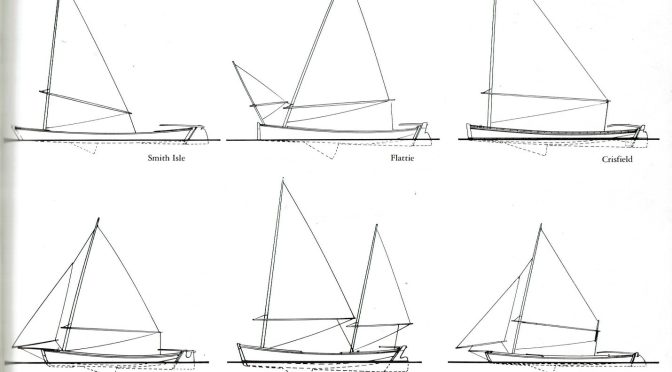
In my early reading about Chesapeake Bay watercraft, I found mentions of different numbers of variations of skiff types.
As I read, I looked for authoritative references, as having the types delineated by HIC, or other authority, I thought, would help me sort out some of the confusing terminology I was encountering. Over the next years when I found numbers of skiff types mentioned I made a note of it.
The following is what I found –
1943 – Howard I. Chapelle [HIC] published two articles about crabbing skiffs in Yachting magazine – republished by the Chesapeake Bay Maritime Museum [CBMM] in 1979 as the monograph, Chesapeake Bay Crabbing Skiffs. [CBCS] (1)
In this monograph he described twelve boats and supported his discussion of each with 12 lines drawings.
He mentioned several other types he was not able to document as fully as he wished.
He offered no enumeration of types.
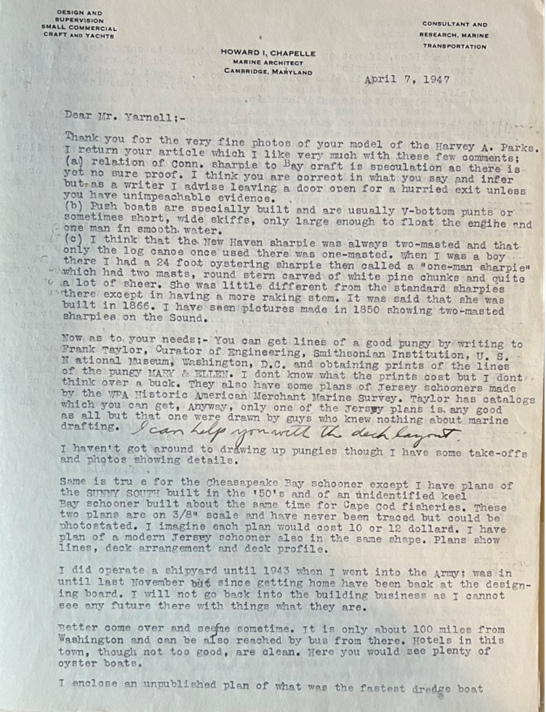
1947 – On April 7 HIC wrote a 2-page letter to Wayne Yarnell [sic] [WBY] in which he mentions, “… the 15 or more variations of the Chesapeake Bay crabbers”, and that there should be models made and a book written about them. HIC clearly indicated he had been collecting information on many small craft. (Appendix 1) [Correct spelling is Yarnall.]
1951 – The classic, American Small Sailing Craft [ASSC] is published.
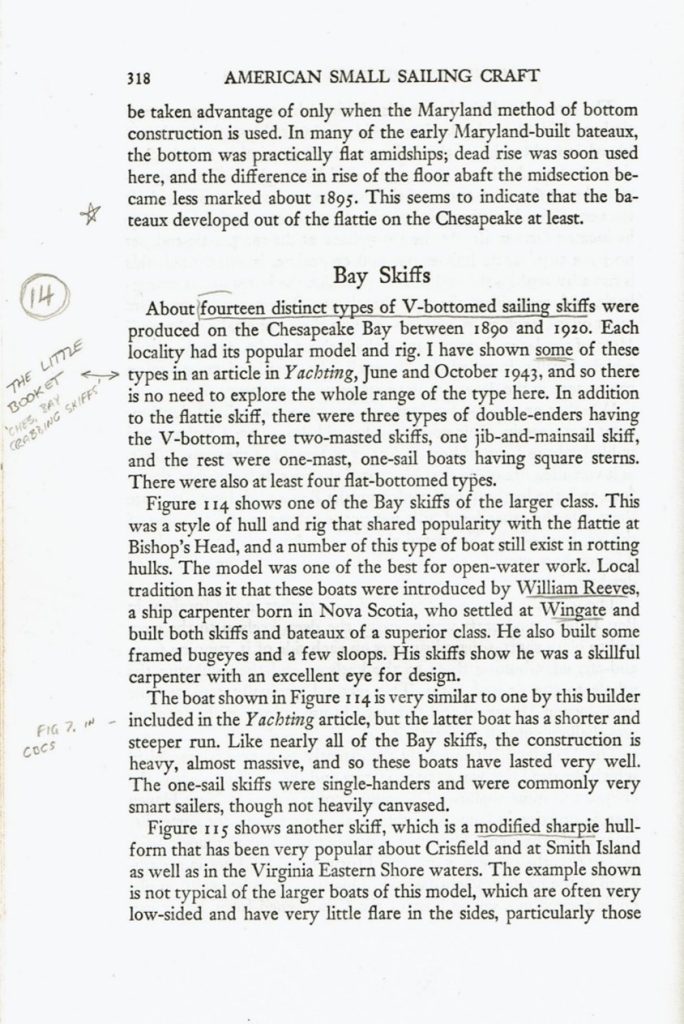
In Chapter 7 [p305] he had just concluded the long section on ‘The Flattie’ [pp309-318] and started the ‘Bay Skiffs’ section with, “About fourteen distinct types of V-bottomed sailing skiffs were produced on the Chesapeake Bay between 1890 and 1920. I have shown some of these types in … [CBCS] in 1943.” “…no need to explore the whole range of the type here.”
But then HIC adds, “In addition to the flattie there were three types of double-enders having the V-bottom, three two-masted skiffs, one jib-and-mainsail skiff, and the rest were one-mast, one-sail boats having square sterns. There were also at least four flat-bottom types.” Note here that HIC emphasizes mast and sail numbers associated with these hull types. (p318, 2) (Appendix 2, and 6)
HIC clearly wrote “V-bottomed sailing skiffs” but then included flat bottom skiffs. It is apparent that later authors simply adopted this 14 number without question.
It appears that this confusing paragraph is the genesis of the “fourteen” reference.
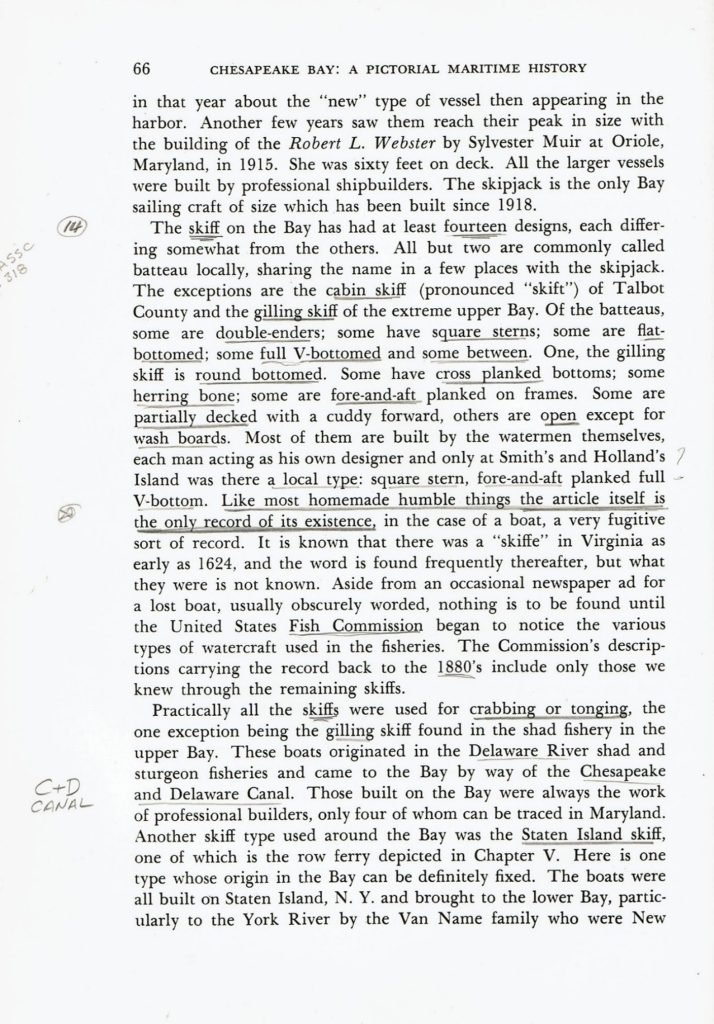
1953 – Brewington repeats “fourteen” types; “The skiff on the Bay has had at least fourteen designs, each different than the others.” but does not give the HIC reference. Note that Brewington identifies about 14 hull variations, without mentioning sail combinations. Brewington’s descriptions seem more organized than HIC’s. (p66, 3) (Appendix 4 and 5)
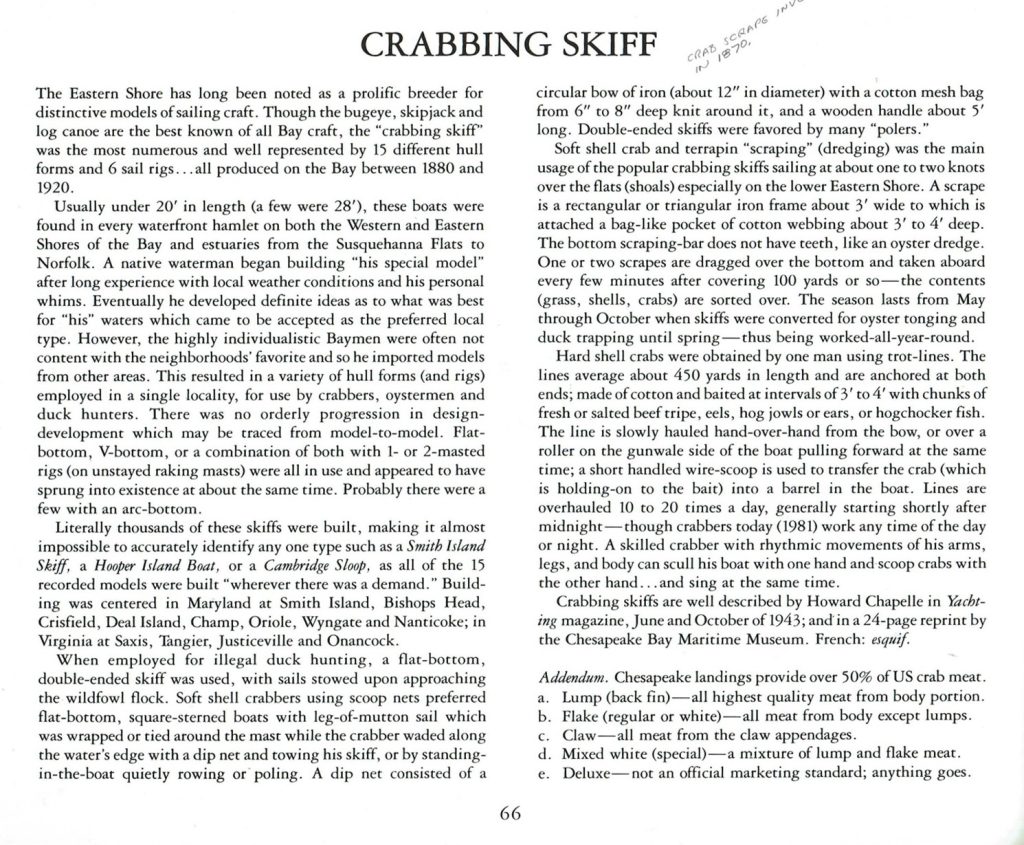
1982 – Tilp in his book, often quoted, or restated, the writings of his friend Howard I. Chapelle. In his essay on CRABBING SKIFFS Tilp did just that – “The Eastern Shore has long been noted as a prolific breeder for distinctive models of sailing craft. …. The ‘crabbing skiff’ was the most numerous and well represented by15 different hull forms and 6 sail rigs… all produced on the Bay between 1880 and 1920.” And further down, “…. as all of the 15 recorded models were built ‘wherever there was a demand .’ But again, no proper enumeration or reference is offered. (p66, 12) (Appendix 8)
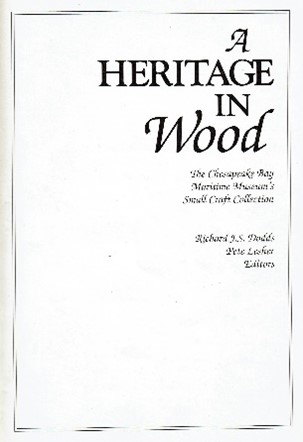
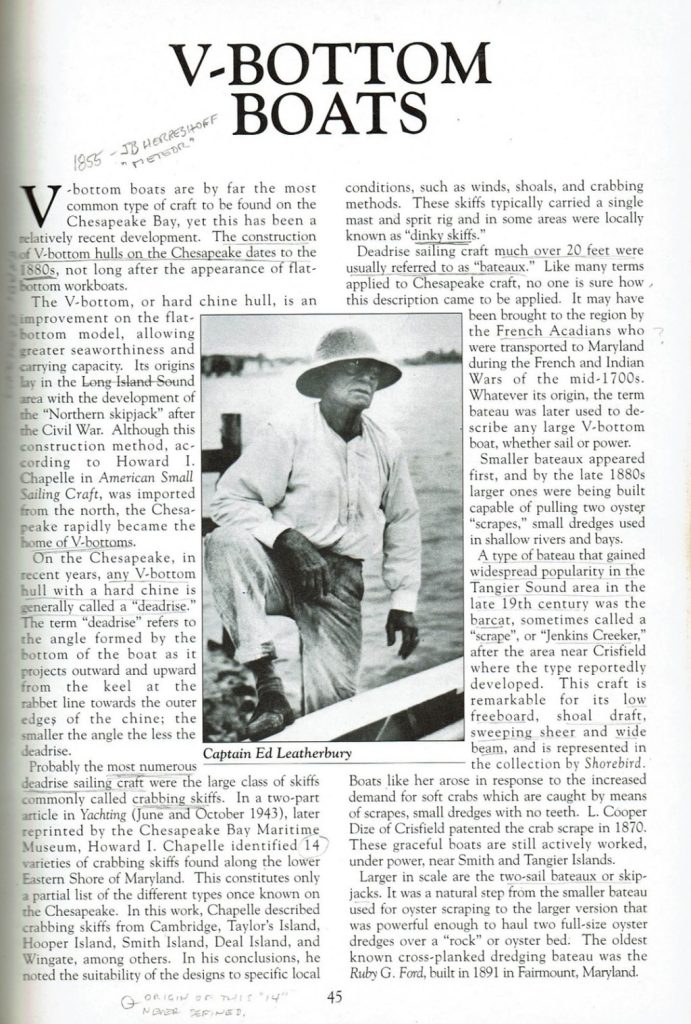
1992 –In A Heritage in Wood, the editors wrote, “In a two-part article… [CBCS, 1943], HIC identified 14 varieties of crabbing skiffs found along the lower Eastern Shore of Maryland.” Clearly an unsupported comment. (p45, 4) (Appendix 7)
Comments – It appears to me that HIC had a lot of skiff types in his head – with all sorts of bottoms and rigs – he needed a number and 15 popped into his mind. (Letter to WBY – 1947)
In ASSC – 1951 – he conflated some ideas about Flatties into Bay Skiffs in general and came up with 14 V-bottoms. I do not see how he “computed” that number.
Later authors erroneously simplified these complications to “14, or 15, types, or varieties.”
So, that’s the end of my search for the mysterious “14” or “15.”
Like much of HIC’s career he leaves us with a number [I’m being purposely vague] of unanswerable questions and incomplete quests – the Webb connection question, the schooner-mate question, the Florida years questions, the shipyard operator question, the property in the Bahamas question, and finally, the overarching question – How did the man do it all ? – the wide ranging research, taking lines and offsets, the marvelous drafting, the multitude of publications, the volumes of correspondence, the huge output.
Mentions are made of his excellent memory, his single-minded dedication to task, the rapidity of his drafting – and – he was a man of good humor. Most of these comments are off-hand and not accompanied by superlatives – why not ? Alan Frazer did refer to him as the “….tireless Mr. Chapelle.” (Appendix 9)
He was able to watch craftsmen perform tasks in a shipyard and turn those observations into chapters and paragraphs in a book. It appears that he did very little, if any, woodworking, on real boats or models, yet he knew how to do it, and was able to describe how it should be done.
He seems to have been able to recall everything he saw and read, and where, and everything he heard, and from whom.
He appears to have been able to write, type, or dictate, the contents of a letter, article, or book – once – with little or no wasted time looking things up or re-writes, and still get it right, the first time, most of the time – remarkable !
References
1- Chapelle, Howard I. Chesapeake Bay Crabbing Skiffs. Originally published in Yachting, June and October, 1943. Republished as a monograph by the Chesapeake Bay Maritime Museum, St. Michaels, Maryland. 1979.
[Mentions double-enders with no, one, and two masts. Also mentions “square sterns”. Only two double enders – fig 1, fig 8 – are shown.]
2- Chapelle, Howard I. American Small Sailing Craft. New York, New York: W. W. Norton & Co., Inc, 1951.
[Fig 37, p 103 (Kakie B) – this is the only Chesapeake Bay double ender here.]
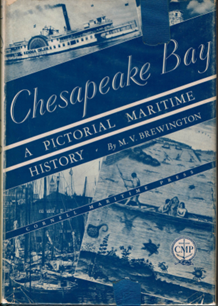
3- Brewington, M. V. Chesapeake Bay; A Pictorial Maritime History, Cambridge, Maryland: Cornell Maritime Press, Inc., 1953. [Appendix 5.]
4- Dodds, Richard J. S., and Lesher, Pete. (Editors) A Heritage in Wood: the Chesapeake Bay Maritime Museum’s Small Craft Collection. Chesapeake Bay Maritime Museum: St. Michaels, Maryland, 1992. [Appendix 7.]
5- Chapelle, Howard I. Boatbuilding – A Complete Handbook of Wooden Boat Construction, New York, New York: W. W. Norton & Co., Inc, 1941.
[Plate 9, p74 = fig 1 in CBCS = Pep. Flat bottom.] [Plates 39, 40, 41 p291ff = 20ft Chesapeake Sharpie. V-bottom.]
6- Napier, Rob. (2002) “A “New” Fair Haven Sharpie.” Nautical Research Journal, v. 47, no. 3, Autumn 2002. Pp. 131-139.
7- Parker, Reuel B. The Sharpie Book. Camden, Maine. 1994.
[Many of his designs are “yacht” modifications of Chapelle’s workboat drawings.]
8- Spectre, Peter H. “The Legacy of Howard Chapelle.” Nautical Quarterly; Essex, Connecticut; Winter 1987, pp. 110-123.
9- Spectre, Peter H. “The Legacy of Howard Chapelle – The study of the maritime past, the preservation of the maritime present.” Peter H. Spectre with the research assistance of JoAnn King, WoodenBoat Magazine/84, September/October 1988. ppg 76-84
(These have essentially the same content with slightly different text and a few different pictures, derived in part from JoAnn King’s material. – an analysis of Chapelle, his limitations, and his considerable contributions to the preservation of maritime history and the vessels. Among the better commentaries on the life and work of Chapelle are these of Peter Spectre. (8, 9).
10- King, JoAnn Jeanelle, Ph. D., Dissertation. – Howard. I. Chapelle: Maritime Scholar and his Contributions to Maritime Preservation. George Washington University, May 5, 1985.
[And the documentation she collected on Howard I. Chapelle: MS78, CBMM collection.]
11- Chapelle, Howard I. Letter to Wayne Yarnell. 1947, April 7. Found by Randle M. Biddle. [In CBMM ? or SI ?]
12- Tilp, Frederick. The Chesapeake Bay of Yore. Chesapeake Bay Foundation, Inc., 1982. [Appendix 8].
Acknowledgement
Randle M. Biddle – My sincere thanks to Randy, whose inexhaustible, diligent, deep diving into the archives of the Chesapeake Bay Maritime Museum, the Smithsonian Institution, and many other archives, brought to the surface innumerable treasures he shared with me and many others.
Appendix 1
[I like to include portions of an HIC time-line to lend context to what he was doing during some of these times.]
Letter from Chapelle to Yarnall – 1947, April 7 – With first mentions of numbers of skiff types, but more importantly he reflects on himself and reveals some ideas for the future.
Page 1 –
Note the formality – “Dear Mr. Yarnell” and “Sincerely, Howard I. Chapelle.” in what is probably their first correspondence. Later they became good friends and collaborators.
Harvey A. Parks mentioned in the first line was a skipjack.
(a) WY probably mentioned a relationship between Connecticut and Bay sharpies that HIC was skeptical about.
(c) Not sure about his sharpie-masting memories here. (6), (7)
[1961 – The Migrations of an American Boat Type: Sharpies.]
“Now as….” Mentions inadequacies of some of the WPA-HAMMS draftsman. They did get some things wrong.
“Same is true….” Discusses [New] Jersey and Cape Cod schooners.
“I did operate….” “I will not go back into the building business….”
“I enclose an unpublished plan of what was the fastest dredge boat….”
Page 2 –
“…in Cambridge,…” “I want to get a good detailed half-model made…when I can afford it; ….”
“I have some lines…” “I build no models and do not have that particular skill; at any rate my time [is] far [better] given up to plans and research. It always pleases me, however, to help model builders. Too many have spent months or even years….only to find out the plans they followed were fakes or poor.” This is one of my favorite passages in his writings. There is a poignancy in it that strikes me.
“Some one ought to get to work on the small crabbing skiffs of the bay….” “…and the 15 or more variations of the Chesapeake Bay crabbers. I have some 10 of the Bay types in plans: on a scale of ¾” few of them would be over 20” overall if rigged.” “Seems to me that a collection of small boat models would have an immense museum value someday.” “I hope to do another book in that field…”
[In 1951 came ASSC; by 1960 he had created the The National Watercraft Collection.]
“Well, come over [and visit]….”
“Sincerely, Howard I. Chapelle.”
———————–
And, he was busy with the sailing navy and fishing schooner books at that time.
1949 – He published The History of the American Sailing Navy.
1950 – Guggenheim. He put Fishing Schooners on the shelf and went to England in 1950 on his Guggenheim fellowship. He published his classic, American Small Sailing Craft – “after 25 years of research” – on his return, in 1951.
Then passed twenty years of remarkable productivity until he came back to Fishing Schooners, published in 1973 just before his health began to worsen.
1951 – American Small Sailing Craft – after 25 years of research.
1954 – BOATS magazine, Practical Fishing Launches Part I, II. May, July.
1956 – BOATS magazine, The American Sharpie Yacht. A five part series.
1957 – Report to the Turkish Government on Fishing Boats.
1957 – Named Curator of Transportation of the Smithsonian Institutions. [1957-1971]
1960 – The National Watercraft Collection.
1961 – The Migrations of an American Boat Type: Sharpies.
1964 – The Bark Canoes and Skin Boats of North America.
1967 – The Search for Speed under Sail 1700 – 1855.
1970 – The Constellation Question.
1973 – The American Fishing Schooner.
1975 – June 30 – Died.
Appendix 1
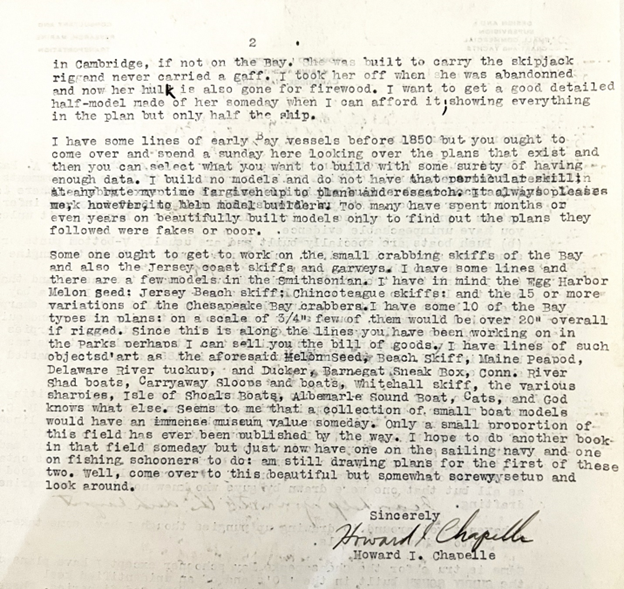
“I build no models and do not have that particular skill; at any rate my time [is] far [better] given up to plans and research. It always pleases me, however, to help model builders. Too many have spent months or even years….only to find out the plans they followed were fakes or poor.”
Appendices 2 and 3 are my effort to count the types – not really possible…. Is it !?
Appendix 2
From ASSC (p318, 2)
He goes on to say:
“In addition to the flattie skiff [1] there were
3 types of double-enders having the V-bottom, [3]
3 two-masted skiffs, [3]
one jib-and-mainsail skiff, [1]
and the rest were one-mast, one-sail boats having square sterns. [1]
Also at least 4 flat bottom types.” [4]
These add up to 9 V-bottom and 4 flat-bottom.
1flattie + 3double-enders + 3two-masters + 1jib-and-mainsail + 1the rest + 4flat =13.
1+3+3+1+1 = 9V + 4flat = 13types.
=====================
Appendix 3
What are ALL the hull/rig possibilities ??? Regardless of whether practical or not.
There were double-ended hulls and square sterned hulls.
Each kind of hull could have 4-kinds of bottom:
Flat + V-bottoms (flattie + modified. sharpie + skipjack) = 8-hull types.
Each could have:
No mast
One mast – w/ 1-sail, 2-sails [stick-up?]
Two masts – w/ 2-sails, 3-sails [stick-up?]
[5-rig combos x 8-hull types = 40 possible types]
==============
What are the V-bottom possibilities ???
Double-end 3-hull types [flattie, mod. sharp., skipjack]
Square stern 3-hull types [flattie, mod. sharp., skipjack]
Each can have:
No mast
One mast – w/ 1-sail, 2-sails [stick-up?]
Two masts – w/ 2-sails, 3-sails [stick-up?]
[5-rig combinations x 6-hull types = 30 possible V-bottom types.]
=================
What are the Flat bottom possibilities ?
Double-enders Flat – 1-bottom type.
Square stern Flat – 1-bottom type.
Each can have 5-rigs:
No mast
One mast – w/ 1-sail, 2-sails [stick-up?]
Two masts – w/ 2-sails, 3-sails [stick-up?]
[5-rig combinations x 2-hulls = 10 possible flat bottom types.]
Appendix 4
From Brewington, p66.
“The skiff on the Bay has had at least fourteen designs, each differing somewhat from the others. All but two are commonly called batteau locally….
“Of the batteaus [skiffs],
some are double-enders 1
some square sterns 2
some flat bottomed 3
some full V-bottomed 4
some between 5
some cross planked 6
some herring bone 7
some fore-and-aft planked on frames 8
some partially decked with a cuddy forward. 9
Some open, except for washboards. 10
Practically all the skiffs were used for crabbing or tonging….
The round bottom gilling skiff and Miles River cabin skiff were mentioned as exceptions. 11, 12
(My numbers reflect number of types mentioned – 12)
Appendix 5
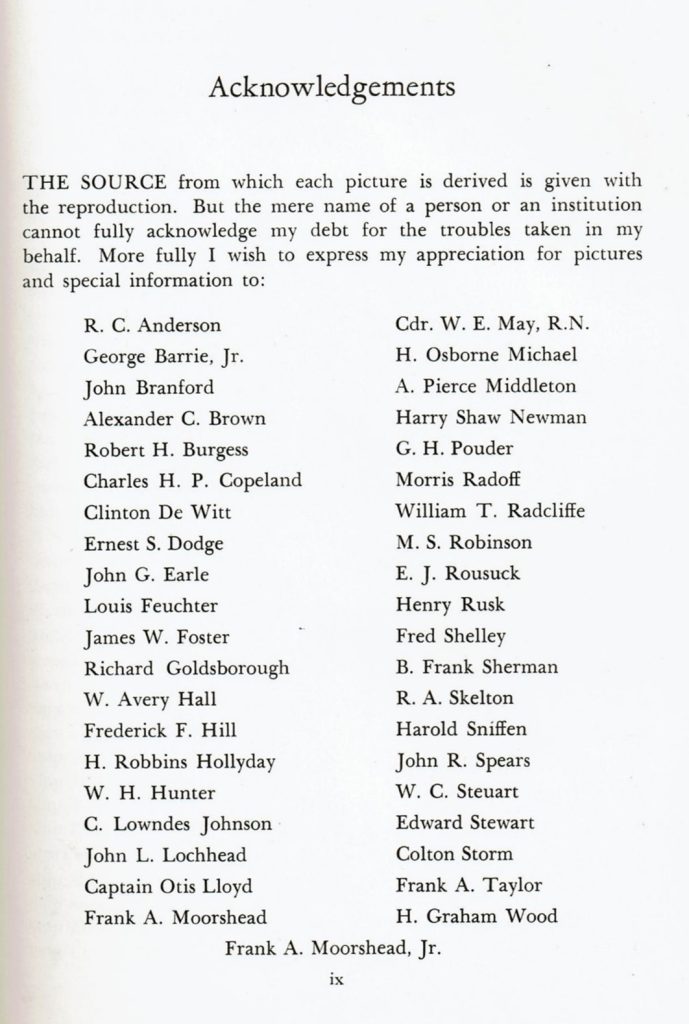
Acknowledgements page from:
Brewington, M. V. Chesapeake Bay; A Pictorial Maritime History, Cambridge, Maryland: Cornell Maritime Press, Inc., 1953.
It is a fascinating reflection on the relationship between HIC and Brewington that the latter did not include the former in the acknowledgements among these greats.
Appendix 6
Appendix 7
Appendix 8
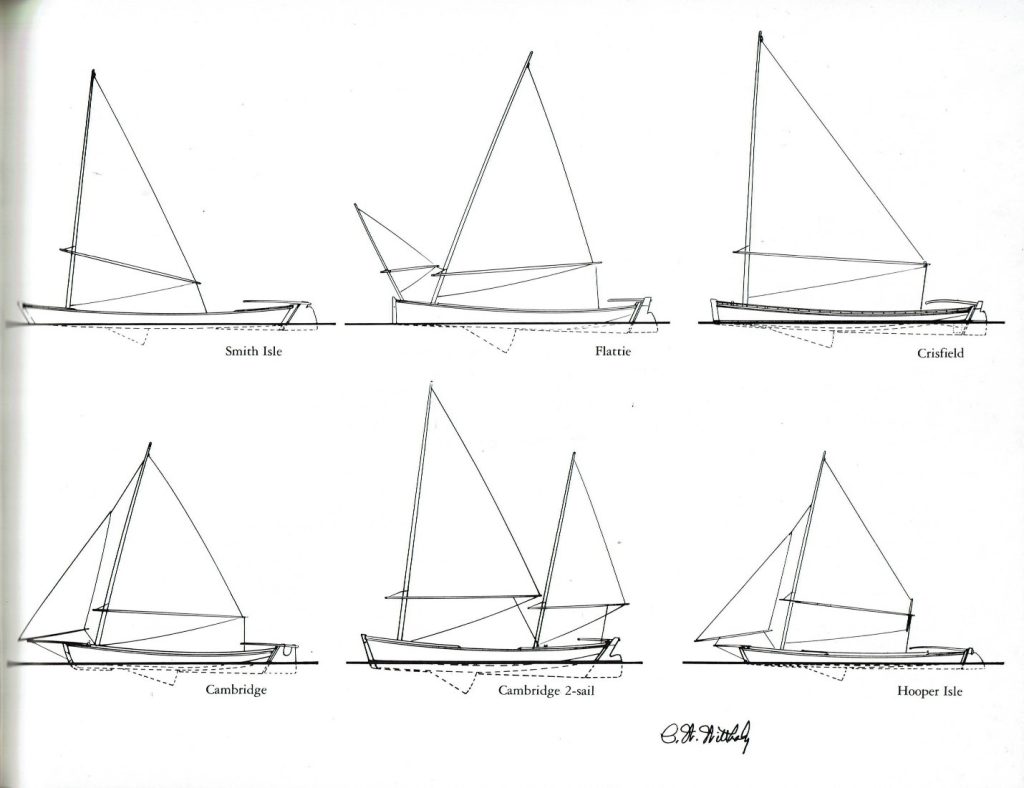
Charles W. Wittholz, NA, naval architect of Silver Spring. Maryland, provided this sketch categorizing by region, some of the types.
Appendix 9
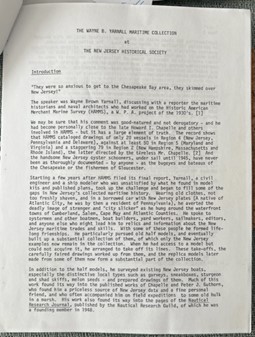
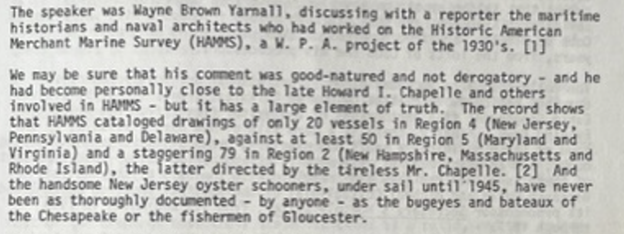
By Alan D. Frazer, Curator/Registrar. March 7, 1979.
“… the tireless Mr. Chapelle.” By Alan Frazer