By Edward R. Thieler III
[See Ed Thieler’s research notes on the Chapelle mural here.]
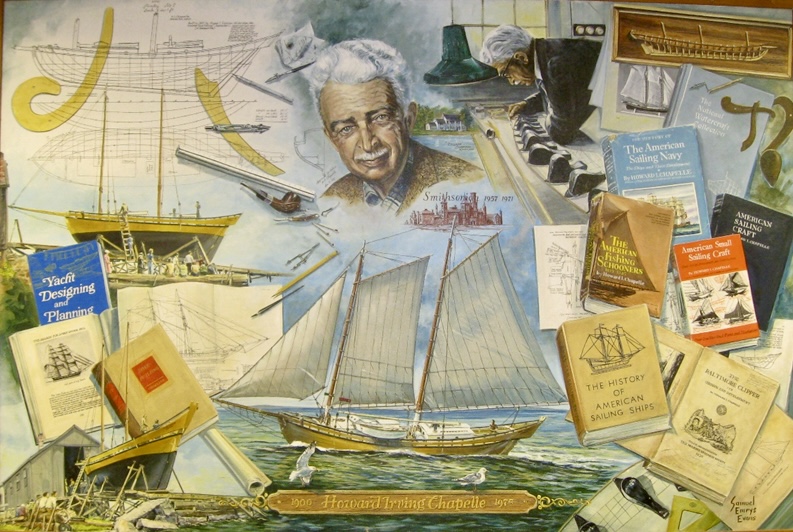
Painted by Samuel Emrys Evans in 1987.
[View or download a larger format images here.]
This mural, about 4’ x 6’, is displayed in the Howard I. Chapelle Library in the Norman & Ellen Plummer Center for Museum Collections on the campus of the Chesapeake Bay Maritime Museum in St. Michaels, Maryland.
Ship’s curves, drafting pens and pencils, a compass, architect’s scale, one of his many pipes, pen knife, and matches, overlay the plans for the pinky schooner Chapelle drew to have his Glad Tidings built. Under that, and in the lower left corner, Glad Tidings is shown just prior to launch in 1937, and in the lower center, under sail.
Chapelle’s portrait shows the man well known for having a pleasant demeanor. To the right he is shown leaning over his drafting table in his studio in his home of 34 years, Tolland, near Cambridge, on the Eastern Shore of Maryland. Tolland is depicted in miniature under the lamp.
The drafting weights depicted are still in use on the CBMM campus – in the boat shop when lofting lines, and by the curatorial and exhibits departments to hold, flatten, and support, items temporarily. Each weight is unique enough to be readily identifiable.
Chapelle’s years in the Smithsonian Institution (1957 – 1971) are represented in the miniature of the original buildings at the top of the mainmast of Glad Tidings.
In the upper right corner is the hawk’s nest half-hull model of Baltimore Clipper Flying Fish, built for Chapelle by William Shepard of Waterford, Connecticut.
Framing the overall scene are Chapelle’s books, a very small representation of his enormous contributions to the documentation of our wooden boat history, from skiffs, to schooners, to war ships.
Chapelle’s name at bottom center evokes a carved, gold-leafed, ship’s quarter-board.
Acknowledgments
The efforts of Randle M. Biddle and Don Barker contributed considerably to this essay.
Special thanks to Gabriella Cantelmo, Assistant Curator, Chesapeake Bay Maritime Museum, whose efforts made ours possible.
Footnotes
Location of the mural https://cbmm.org/library-and-research/
1937- Glad Tidings of Searsport, Maine, 39’ pinky schooner, was launched. At the time he lived in Wollaston, Massachusetts. He approved his plans for construction on April 9, 1937. Boat built during 1937 by Roger Sawyer, Milbridge, Maine.
1940 – He bought “Orem”, an old [100yrs] pillared manor house and 185-acre farm on Town Point Neck, overlooking Fishing Creek, outside of Cambridge, Maryland. He named it “Tolland” for his birthplace in Massachusetts. He enjoyed the fact that it was often an island at high tide and was almost afloat at extreme high tides. “I know enough about farming to know that I’d lose my shirt if I tried it ….so I rented it out to a farmer and let him worry about the asparagus.” Visitors were told to: “Go past the Antioch Church and turn left.” He commuted from there to Washington, DC for years and, as we all do, complained about the traffic. “When he was not at Tolland, he was at the Smithsonian Institution”. He ended up living at Tolland 34 years, until 18 months before he died, in1975.
(On 8-5-1940 – purchased from The Federal Land Bank of Baltimore.)
1957 – Named Curator of Transportation of the Smithsonian Institution.
When appointed to the SI he said he wanted to tell the story of the history of American sailing craft in chronological order and to show the different types of inland and bay craft. He traveled the American coasts and Great Lakes in search of records of appropriate vessels. He enlisted the skills of a number of the most famous model builders in the country to build and restore models, after he and his staff certified the authenticity and scale of what was being done. Since the models were built to a number of different scales, he had appropriately scaled figures placed on the decks to better demonstrate the size of the vessel. Over two hundred models were built or restored under his direction, and he wrote all of the display labels for them. He maintained a place to live on the western shore [Alexandria, Virginia; Oxon Hill, Maryland] when he had to be closer to the Smithsonian.
======================
Hawk’s nest model
See; Chapelle, Howard I. The National Watercraft Collection. 2nd ed. Smithsonian Institution Press, Washington. D. C. and International Marine Publishing Company, Camden, Maine. 1976.
Picture on p.11.
[Year made not known, donated by Alice Zayma Chapelle to CBMM in 1979.]
=========================