By Randle M. Biddle
Thoughts on the Evolution of the Single-Masted Sloop in North America and the Caribbean
As a result, fast sailing craft were in great demand; to meet the existing conditions the ‘Jamaica Sloop’ was developed and soon became very popular.
Howard Chapelle, Yachting, 1933
One of the personal benefits of my research into the origin of Chaleur was becoming acquainted with the poorly documented, and nearly forgotten shipbuilding activities along Jones’s River at Kingston, Massachusetts. Proving that Chaleur was originally a sloop built in that town encouraged me to learn more about her type, which from almost the earliest colonial period became emblematic of American merchant sail for more than one hundred years.i
Of the more descriptive artifacts and ephemera we wish would have survived only a few draughts, and equally rare contracts or wills, are to be found. An eighteenth-century builder’s half-hull for a representative sloop, with clear provenance, would be too much to hope for. The greater share of images of the work-a-day sloop are in a similarly small number of contemporary drawings and paintings. Although a few works of the nature of ship portraiture survive, many of the sloops are included only in the distant and indistinct background, or as accompaniment to larger vessels, and less completely rendered. Moreover, I have yet to find an eighteenth-century picture of an American sloop, with the location where she was built identified.
To my knowledge there is only one intersection in the secondary source literature of early American shipbuilding, between Kingston and her shipyards and the construction of sloops in general. William Avery Baker calls it out, but his comment describes the building of sloops at Kingston, at about the time the type was declining in favor of the schooner and brig: “On the Jones River in nearby Kingston we find that, of 130 vessels constructed during the same period (after 1783) for owners in Kingston and the adjoining towns of Duxbury and Plymouth, 23, nearly 18% were sloops…many may have been Boston packets.” We know that shipbuilding on that stream began as early as 1713. At that date and for a long while afterward we might easily conclude that the preponderance of vessels launched there were sloops, and probably small ones as well. If for no other reason than the mile and one-half long waterway to Kingston Bay was narrow and winding, and comparatively shallow even at highest tide. My research found, that regardless their size, prior to the American revolution, many traded to Halifax and Liverpool in Nova Scotia, “New Found Land,” Quebec, to the Caribbean, and to the Azores and Africa.ii
Part of my project was attempting a responsible reconstruction of the appearance of Chaleur in her original rig. First as a merchant sloop, and soon after when armed in British naval service. Examining the evolution of the type in size (Chaleur was large at over seventy feet on deck), the influences on hull form, masting and spars, and sail plan were essentials to render her correctly as a sloop. For the North American and Caribbean sloop as types, Chapelle and Baker, Charles Gerard Davis, E. P. Morris and others preceded me in a similar quest, but in a more general way. A Captain A. J. Kenealy relates the type’s history this way:
The sloop, as a distinctively American vessel, probably arose from the mother country forbidding by law the colonists from building any other type of vessel. The little craft one sees plying up and down the noble Hudson, and making good weather in strong winds, are all that is left to remind us of what was once a great industry, but which was most effectually wiped out by the introduction of steam.iii
Let us continue with two articles from the 1930s worth examination as indicative of the thoughts, findings and syntheses of Chapelle and Davis about the evolution of the sloop in New England and the Caribbean.
Fig. 13.1: Merchant Sloop vignette: Map of the district of Maine, Massachusetts, compiled from actual surveys, 1797. Carleton, Osgood, 1742-1816, Created / Published, Boston (1800?). Courtesy of the Massachusetts Historical Society.
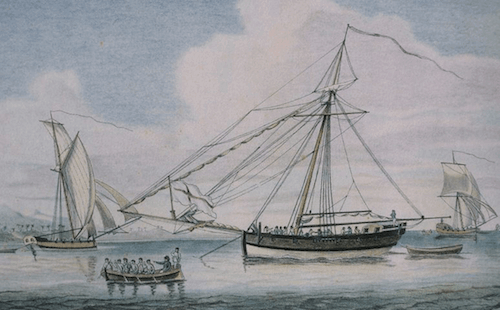
Fig. 13.2: A Bermudian Sloop with a view upon the Spanish Main: “This aquatint by J. Clarke and J. Hamble is after a Dominic Serres painting executed prior to his death in 1793, though it was not published until 1806 in the second part of a book titled Liber Nauticus.” Caption by Merritt A. Edson, Jr. as published in the Nautical Research Journal 30, no. 4 (December 1984): 185.
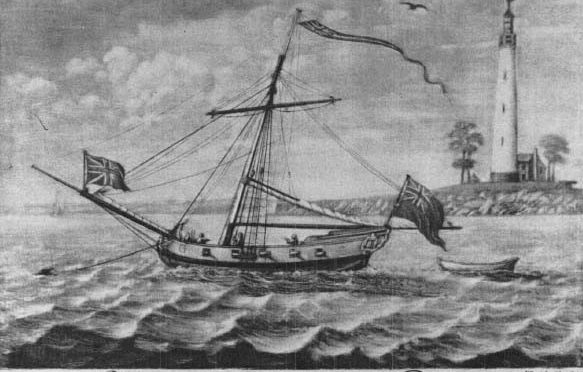
February 1933 Yachting contains Charles G. Davis’s: “The Development of the Sloop: The Evolution of the Single Mast from the Early Dutch Boats of the 17th Century.” Davis was undoubtedly known to Chapelle. The Davis survey period begins earlier than the 1750-1770 span of greater interest to me in my studies. It deals primarily with the evolutionary path between Dutch vessels present in the New World—in and about New Amsterdam (later New York)—and their eighteenth and nineteenth-century descendants. Those North, or Hudson River sloops like the well-known, and oft-modeled Victorine, and the much earlier Experiment that went to China. What is of interest are the lines drawings (draughts) Davis provides for two early sloops. And his mention of and renderings of the Pacific Northwest exploring sloop Union, and Burgis’s painting commonly described as Sloop off Boston Light.iv
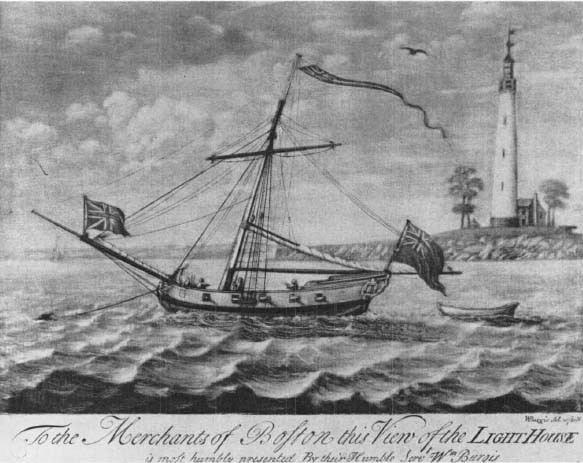
Fig. 13.3: Sloop off Boston Light: Mezzotint by Burgis. Courtesy of Mystic Seaport Museum.
Because one of Davis’s draughts is of a sloop of 1765, “drawn from table of off sets from Mungo Murray’s Naval Architecture” we might conclude that this same sloop was the one which caused Chapelle to mention his reliance on Murray when interpreting Chaleur from the Admiralty draught. Davis reconstructs another small sloop “as laid down from measurements in Steele’s work on naval architecture, [therefore] we have two intermediate steps between the ancient and modern sloop plans.”
Fig. 13.4: A 50-ton Sloop of 1765: Drawing by Charles G. Davis based on offsets by Mungo Murray, presumably taken off an actual vessel of that period. Courtesy of Mystic Seaport Museum.
Perhaps because of Davis’s own considerable interest in ship model making, and his several books promoting that art and craft, we see that he has amplified the draughts with a possible deck layout, and indicates these small sloops were steered with a tiller.
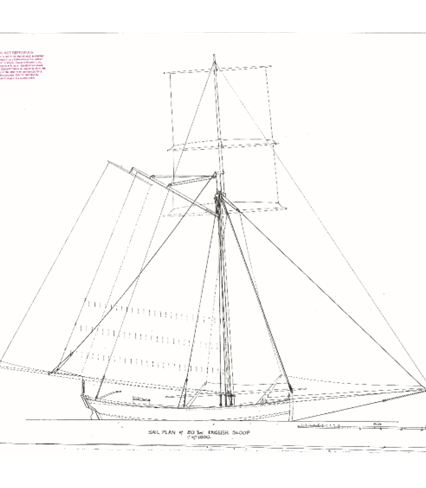
Fig. 13.5: Sail Plan of 50-ton English Sloop of 1800: Drawing by Charles G. Davis. Even though the dates are different (1800 v. 1765), and the works made some years apart, this sail plan is believed to have been developed by Davis to accompany the hull based on offsets by Mungo Murray. Courtesy of Mystic Seaport Museum.
Davis followed this practice in his interpretation as plans and a scale model of Experiment (for which no half-hull or draught is known to exist). He also included details of masting and rigging. Chapelle, as is known, commonly applied such informed speculation in producing his renditions of Admiralty (and other draughts) throughout his career.v
Fig. 13.6: Experiment a Hudson River Sloop of 1785: 1:48 scale model by Charles G. Davis. The late Arthur R. Herrick, Jr. told me this work, item 1940.383 in the Mystic Seaport Museum collection, is not the same model described in Davis’s “Bulletin No. 8.”vi Image courtesy of Mystic Seaport Museum, Mystic, Connecticut.
Davis also influenced, or possibly even mentored another ship model maker, who would soon surpass Davis in that art form. From the caption to a photograph of a model of another sloop from this period, we read: PROVIDENCE made by A. S. Brownell; handwritten on back by Davis “Sloop PROVIDENCE of 1776 made by A. S. Brownell of Prov. R.I. from plans by C. G. Davis.”vii
In April of the same year, and also in Yachting, Chapelle writes about Bermuda Sloops and Dinghies: The Development of a Type Taken over from Jamaica, and of the Bermuda Dinghy.
In this short piece, typical of those in early numbers of Yachting on a variety of interesting maritime topics, Chapelle gives us a hint at what is to come from his pen, in book form in 1936 and then in 1939. Although the exemplar he uses is the Bermuda sloop Lady Hamond of 1804, the earlier portion of the article speaks to the evolution of a particularly fine hull—fast and able with a single-masted rig—first appearing in Jamaica in the 1700s and its adaptation to become the “Bermuda sloop.”viii
Upon close inspection of this article, Rob Napier, made a most interesting discovery:
Decided to see how the Yachting article compares with the relevant chapter in Chap’s American Sailing Craft, which came out later in the 1930s. Each chapter of the book had been an article in Yachting, and I have always wondered if Chap reworked the articles prior to their coalescence into the book. I just read both side by side. There are expected differences in style, all of which have to do with the presentation of dimensions as numbers. Figures numbers differ because those in the article start with 1, and those in the book flow through the entire book. Otherwise, I found only one word different. It is in the 5th line from the bottom of the last paragraph of the first column on the first page of the article. In the article, Chap wrote, “To these they gave rather fanciful names…” In the book, this was changed to “To these they gave rather ‘pretty’ names…” It was a sensible change.ix
The Jamaica, and eventually the Bermuda sloop (with Chapman’s drawings of an unidentified sloop, and the 1741-42 Mediator as the best documented examples) were roughly contemporary with Chaleur (1763). Because of the frequency of entries in the Boston Naval Office Returns showing vessels trading between Boston and ports in the Caribbean, Virginia and the Carolinas, I believe the designer or builder of Chaleur may have been influenced by the Jamaican model. Other than the Bermuda sloop example that Chapman recorded and preserved for us, Chapelle had only contemporary paintings and drawings from which to draw conclusions about the appearance of these vessels. At least until he later discovered the Admiralty draught marked Marble.Head which we will discuss elsewhere. The Bermuda sloop Lady Hamond (1804), is treated further by David MacGregor in Fast Sailing Ships.x
Fig. 13.7: Lady Hamond (1804): Admiralty draught 6657 ZAZ6436
Central to an exercise of comparative naval architecture vis a vis Chaleur, later we will study the few examples of early sloops for which we have draughts of one degree of completeness or another. And, incorporate dimensional and configurative data from drawings, paintings and primary source textual descriptions in newspapers, contracts, and similar ephemera.xi
Chap’s esteemed colleague, William Avery Baker, has quite a lot to say about the sloop as a type during the American colonial period. Regrettably, I must begin with the same observation about Baker as I have shared about Chap. On this topic at least, neither seemed much interested in looking at the archival material. They were both visual artists and trained naval architects (Baker more so than Chapelle), and the physical form of the vessels they studied seems to have been of greater personal importance. For example: “there is a considerable gap in the statistical and technical data concerning such craft although the quantity of pictorial information increases rapidly. The main body of colonial shipping records for the eighteenth century prior to the American Revolution is missing, but there are enough bits and pieces to indicate that during this period the sloop was the favored type of small trading craft.” There is every reason to agree with Baker’s conclusion, but he is not correct about the “main body of” eighteenth-century shipping records “being missing” unless he is referring to the Custom House records for Boston and other ports prior to the American Revolution. As I have emphasized elsewhere, the Naval Office Returns for the Ports of Boston and Halifax (Nova Scotia) are an exceptionally rich repository of such data. His comment suggests personal research in that material may not have been done by Baker, just as it is clear that Chapelle did not much investigate them either. Baker seems to have relied heavily on what was preserved in the Massachusetts Archives. That was not a particularly useful collection for my purposes because there seemed to be a dearth of records for the period between the end of the Seven Years’ War and the beginning of the American revolution.xii
Fig. 13.8: A Sloop at Anchor…Ditto Under Way or Sail: a wash drawing attributed to Dominic Serres. Courtesy of the National Maritime Museum, Greenwich, England. As was common in these portraits, we have two views of the same vessel in the frame. A portside view, and a port stern quartering view with the topsail sloop going away on the port tack.
Baker makes full and thorough use of the “quantity of pictorial information.” His commentary leads us through the evolution of the predominant single-masted sloop rig in North America and the Caribbean, before the type was subordinated to the schooner, brig and brigantine for larger capacity and greater security in transoceanic commerce. We know that there are few well-documented examples to present and analyze, and like many others, Baker begins with the Sloop Off Boston Light and compares it to the English-built sloop, Ferrett. He interprets the former as more like the “wood sloops” which were common in New England, and shared characteristics with Dutch sloops; which were of course, the first sloops almost by definition in the New World. The rig of these earlier vessels was characterized by their loose-footed mainsail, short gaff, long boom, staysail and jib; possibly a flying jib, topmast fidded abaft the mainmast, and a square topsail. Baker offers that about 1760 gaff topsails (of a type unspecified by Baker) begin to appear. The closest examples I found were of the jackyard topsail variety.xiii
Fig. 13.9: Ferrett (1711): British Admiralty draught of this “Slupe.” 3779 ZAZ4877
Fig. 13.10: Ferrett (1711): Reconstruction by Howard I. Chapelle.
In company with Chapelle and Davis, Baker also presents the sloop type of the Chesapeake, the form of which was increasingly and heavily influenced by sloops built first in Jamaica, and soon after in Bermuda. The Virginia and Maryland-built sloops were to the model of the Bermuda sloop (see Chapman), including the distinctive crowned quarterdeck roof. The Jamaican forebear shows drag to the keel, high deadrise, raking ends (and in the case of Mediator, a tumblehome in the stem) low freeboard (enabling the use of sweeps in some cases) and a steeply raking mast. Those built in Bermuda were of the very light but strong Pencil Cedar. In comparison to Mediator, Baker examined Chapman’s Bermuda sloop, English “Wine Sloop” and “Hoy” and Ferrett (1711). With the exception of the Bermuda sloop, the other draughts are quite incomplete. Baker’s minimalist renderings of those draughts do give a sense of the shape of the hull. I found other single-masted sloop examples in the National Maritime Museum collections at Greenwich, but the date and place of their construction may not be coincident with our period of interest. The Bermuda sloop is much sharper and finer even than Ferrett, a naval vessel.xiv
As merchantmen—and when circumstances warranted, as privateers—sloops were numerous in the rum, sugar and molasses trade, and probably as small slavers from the West Indies in that triangle trade back to New England. Some claim them to have been the favored craft of buccaneers. “We can assume, however, that an ordinary trading vessel sailing in less hazardous waters would not have needed the extreme characteristics of the Jamaica or Bermuda sloop.”xv
During the 1760s the preponderance of vessels trading from New England ports, and probably from the Southern colonies as well, were sloops. The greater share of that type would have been designed and constructed for carrying a variety of cargoes as may have been opportunistically presented to the vessel owner or Master. The sharp models just described were not as accommodating of such a broad range of cargoes, or for commonly or regularly making passages of a great distance in the open ocean. Baker calls the larger and less sharp modeled carriers “sea-sloops.” They showed much less deadrise in their floors, less drag aft in their keels. Accordingly, masts would be stepped a bit farther aft, with less rake. Baker deduces then, a large number of the North American sea-sloops of the eighteenth-century that traded across the Atlantic prior to 1775 had hull forms similar to that of Chapman’s wine sloop. That would make them slightly burdensome, and less tender, but also, likely to mitigate against the loss of cargo. They traded the lower risk, against the delays of meeting a market due to slower passages. Lumber, and tobacco in casks were common eastbound cargoes while the sloops often returned with wine from Fayal and other distant ports.xvi
Vessels wanting to transport lumber, and in particular mast timbers, became a special case fairly early in the development of the colonies.
One such cargo was lumber, which before 1775 could by law only be imported by Great Britain from her North American colonies in sloops. For this trade there were sloops even larger than Ferrett or Mediator. One of 140 tons burthen was built on the Kennebec River in Maine in 1772. While plans of these large lumber sloops are not available, there are reasons for believing that they probably differed but little in form from the many moderate-draft full-bodied sloops shown by Chapman.xvii
Had Baker known Chaleur was a sloop, her burthen of 116 91/94 measured as “King’s Tonage” would have ranked her much higher than her sisters against the sloop built in Maine. In fact, even before and after I learned of her actual cargoes as a merchant sloop, I thought it reasonable that she was built to fetch lumber and even mast timbers for the shipyard of her birth.
Baker was a helpful secondary source in my work to reconstruct the appearance of Chaleur in her original merchant sloop rig. His descriptions, gleaned and synthesized from the contemporary draughts, drawings and paintings already discussed are quite comprehensive. The last passage also helps explain how a large sloop like Chaleur with a crew of but three men including the Master, might have handled a particularly large, wet and heavy mainsail in a blow.
Concerning the rig of the eighteenth-century sea-sloops, there seems to have been a fairly consistent combination of fore-and-aft and square sails. In the former category there were the mainsail, foresail, or what we today would call a staysail, jib and flying jib—gaff topsails appeared after the middle of the century. For square sails there were the course, topsail, and sometimes a topgallant…perhaps a tonnage of about 50 marked the limit for the fitting of this sail…The smaller sloops intended for bay and river use where much tacking was necessary seem never to have had square sails.
We have noted that prints from the early eighteenth century show that when fore-and-aft mainsails were fitted with booms, they had short gaffs. When furled such a sail was not secured to the boom but first to the gaff, which was then hoisted part way up the mast, and the remainder of the sail made up in a long roll out to the end of the boom. The foresail or staysail was often shown furled in stops along its stay while the jib was furled on the bowsprit.
From Baker’s further comments and my own observations of essentially the same views, I would agree with him in his description. Gaffs do become longer by the middle 1700s. The gaff on Mediator and Chapman’s Bermuda sloop—as Baker notes—works out to about nine-twentieths of the length of the boom. As to reef points: the larger sloops’ mainsails normally had three rows of reef points, foresails two, and jibs one; no reefs were shown on the square sails (courses). This overall configuration would be true for both the sharper Bermuda and Jamaica sloops, and the Wine sloop, with the exceptions noted earlier dependent upon differences in hull form.xviii
Fig. 13.11: Chapelle’s reconstruction of the sail plan of Mediator using spar dimensions on the original Admiralty draught. Note the similarities between this rig, and for Chapman’s Bermudian presented by Chapelle in his The History of the American Sailing Navy (1949). It is fortunate indeed that spar dimensions were preserved for two near-contemporaneous exemplars of this type. See my Chapter 27: “Two Brothers ~ Interpreting Her Appearance” on the use of these dimensions and those of other sloops to reconstruct lengths and proportions of spars for that slightly later (1762-1763) sloop.
I do not recall reading any commentary by Baker, Chapelle, Davis, or Morris about views of vessels made in the Canadian region of northeastern British North America. However, the works by DesBarres frequently show single-masted sloops. Often with enough clarity that at least some proportional correspondence can be made between hull length (on deck) and mast and spar dimensions.xix
Fig. 13.12: A Sloop in the Vicinity of Halifax: This small sloop appears to carry a square, fore course, but not a square topsail. Her topmast is fidded abaft the main mast. Courtesy of the National Maritime Museum, Greenwich, London. HNS 51B Repro IDK0133
Extracting data from another contemporary description of a sloop gives us an example of the proportions of mast and spars and the dimensions of her mainsail and foresail or jib (archaic spelling preserved):
I want a Suite of Sails near about that biggness for an old Sloop I have here, of about Sixty Tons; the boom is fifty four feet long, the gaff Eighteen feet long, the Mast is from the houns to the deck forty nine feet, the bolsprit steves pretty much, and is from the Stem to the Jibb Stay hole: about Twenty Seven feet; I do suppose that it will take about ten bolts of duck for the three Sailsxx
In the accumulated literature on early North American and Caribbean sloop development, there appears to be but four or five, fairly contemporaneous and serious students of this type. In addition to Charles G. Davis, William A. Baker, and Howard I. Chapelle, let us now turn to E. P. Morris and his comprehensive 1927 survey, which included among many other types, the single-masted sloop. The important contributions of John F. Millar, Hewitt R. Jackson, Rob Napier, Dr. Clay Feldman, David Antscherl, Trevor Kenchington, Colan D. Ratliff, Karl Heinz Marquardt and Erik A.R. Ronnberg, Jr. are also to be commended. And, of course Fredrik Henrik af Chapman who long preceded us.xxi
Morris writes before anything appears—at least in book form—by Charles G. Davis and is oft-quoted by successors to present day. Davis wrote in Yachting magazine about his thoughts on early sloops only a few years after the publication of Morris’s work, but without reference to Morris. I do not know the extent to which Davis and Morris might have been personally, or through correspondence acquainted with one another. Even though many who spent their entire lives on or near the water were still with us at that time, writers about the early days in American merchant sail, were a very small fraternity. Marion V. Brewington came on scene in the early 1930s as contributor and board member for The Mariner, and later The American Neptune, but not until much later as an author. His emphasis was on the smaller craft of the Chesapeake region where Brewington lived.
As we know, Chapelle and Baker frequently exchanged, and Davis was still active as a writer, model maker, and in ship model repair until near his death in 1959. He may have been communicating with at least Chapelle and Baker. Baker, writing decades later, will quote Morris and quote or acknowledge Chapelle. A search of the papers of Chapelle and Baker revealed their exchanges, but I did not review Davis’s papers, most of which are at Mystic Seaport, Mystic, Connecticut. In 1930 Chapelle notes that Davis (and C.H. J. Snider who emphasized Great Lakes maritime history) “have been consulted and much of value in connection with the Baltimore Clipper has been found in books written by them.” In the Preface to The Baltimore Clipper (TBC), Chapelle acknowledges Morris: “To Prof. E.P. Morris of Saybrook, Connecticut, belongs much of the credit for this volume, he having made the suggestion that plans being brought together merely as a private collection be incorporated in a book on the subject.”xxii
Morris does not appear in the list of those acknowledged or as authorities in Chapelle’s The History of American Sailing Ships (THASS) and died before Chapelle’s American Small Sailing Craft (ASSC) was published in 1951. Therein Chapelle thanks Morris, in a reference germane to my project: “The late Professor E. O. Morris, in his well-known book, The Fore and Aft Rig in America, made a full report on the names of boat types in colonial records.”xxiii
We do see however, a continuum of thought and opinion, with each chronological successor—or for a time—contemporary, accepting the work of their forebears, or colleagues. Sometimes, without any apparent contradiction or reservation, or building upon or adding to earlier foundations. Seldom do any of these students of sloops and other craft draw new, original inferences or come to alternative conclusions or interpretations; about the sloop as a type, or about particular sloops. In one rather glaring case, we do see the work of a predecessor incorrectly applied, in an attempt to reconstruct the appearance of a vessel contemporary to the selected archetype.xxiv
One striking observation is the very small bibliography in Morris’s book. The entries for the most part, are of secondary sources. The remainder are references to contemporary drawings or illustrations as did Chapelle, Baker, and Davis (and in the case of Chapman, references to plans of sloops). As the first mover in the field, or about the sloop type at least, the scarcity of useful illustrations in The Fore and Aft Rig in America is regrettable. As Morris reminds: “One other fact in the history should be mentioned, though it has little to do with rig; the sloop was more widely used within certain limits of size and time, than any other American rig, perhaps more generally for all purposes than in England or Holland.” This observation is absolutely consistent with the eighteenth-century views of American port cities which include sloops of every size, variations in rig, and differing portraits; under sail, coming to a mooring, or near the water’s edge. And to be fair to all these pioneers, that was and remains, the bulk of contemporary evidence come to light as to the appearance of sloops of that period.
In his own complaint about the scarcity of reliable contemporary information, Baker echoes Morris, perhaps out of having studied Morris’s work. The limited existence of useful material is just one more indication of the “lack of appreciation in the general population for recording (or preserving) the commonplace.”xxv
Morris admits a heavy reliance on a few pictorial artifacts: “the most important pieces of evidence are the two views of New York and Boston by William Burgis, published about 1717 and 1725.” Further, he devotes several paragraphs to establishing the likelihood of the artist having first-hand acquaintance with the waterfront and taking great pains to render an accurate view, subject to his limitations as an artist as regards the use of proportion and perspective.
Such trifles are evidence of carelessness in drawing, not of ignorance or carelessness in observation. Other details, in themselves not important, show that the artist was interested in recording facts; two men in the New York IV [referring to the version of the view of the ‘port’ of New York] are putting a lashing around the lowered yards; just below that craft a man is standing in the stern of his rowboat, sculling her; on the small sloop in the foreground the gooseneck [on the main boom] is carefully drawn…on the whole these prints give the same kind of trustworthy evidence as the contemporaneous Kip drawings and afford a secure foundation for the history of the eighteenth century rigs.
Because Morris was the first to seriously approach the evolution of watercraft built in North America, and because his writing reveals him to be a highly skilled, inquisitive, and insightful student of the available material, I am inclined to conclude that Morris “found” most of what could be found in his day, except… we see no evidence of him seeking out collections of ship’s draughts in the repositories of the major museums then extant, here and abroad. That work seems to have first been performed by Howard Chapelle. To be fair, Morris, Davis, and initially Chapelle had very little from which to begin to accurately portray the sloop as found along the American cost c. 1700 to 1800. Morris’s comprehensive investigation of the available materials leading to his comments about the specific details of the sail plan and rigging of early sloops will be found in my chapter about reconstructing the appearance of Chaleur in her original merchant sloop configuration. Morris also makes the distinction between sea-sloops and coastal sloops; a separation we see carried forward into Baker’s work, and in Chapelle’s to a degree.xxvi
Morris did turn to collections of ship models in museums and private hands. He is careful in his assessment of what these three-dimensional objects might tell us, because he clearly understands that the primary resource basis for them in many if not most cases is either not known, or suspect.
It might be expected that models, of which there are collections, both public and private, in the United States, and to which much interest has been directed in recent years, would be a fruitful source of information; a model has at first sight an effect of authenticity greater than that of a description or a picture.
To serve as a perfect piece of evidence a model should have been made by one who knew the vessel, who could get precise measurements, whose purpose was to make an exact copy and who had the mechanical skill to do it.
Morris rather painstakingly dissects all types of sources: models, drawings, paintings whether contemporaneous with our period of interest or not, and demonstrates a high degree of skepticism as to their worth in reconstructing accurately a single-masted sloop of those times. After presenting commentary about certain models and noting collections of photographs of some of the more important models available for study, Morris regardless cautions us that: “Even with these there is the possibility that the plan may have been changed in building and the greater possibility, if the model is rigged, that the rigging may have been injured and then inaccurately restored.”xxvii
Chapelle enjoyed the significant advantage of working from an Admiralty draught (in our case of Chaleur) as a basis for reconstruction. With for the most part, only the pictorial record, Morris presents but simple pen and ink drawings showing the most rudimentary of detail, as being generally indicative of form and rig. Because of his emphasis on rig, or perhaps because of the absence on Morris’s part of any knowledge of a draught like that of Chaleur (save those by Chapman, which excepting his Bermuda sloop, were not North American vessels) we do not see any attempts at reconstructing a set of lines. The author John F. Millar, writing at a much later date, made such speculative reconstructions of lines for many colonial period vessels, including a few sloops. Millar’s drawings—as are those of Hewitt Jackson—were based upon essentially the same, or similar materials available to Morris, Davis, Chapelle and Baker. To their credit, Millar and Jackson are equal to Morris in their candor about sources, and their limitations in enabling an accurate reconstruction of the true appearance of these small but numerous players in our maritime history.xxviii
For single-masted sloops it would appear, with the discovery of the Admiralty draught of Chaleur (even in a schooner rig) we have a singular opportunity to complement the pictorial and textual record and to eventually approach a supportable, if not totally precise rendering—in two and three dimensions—of at least one documented example of a once, most prevalent type.
Fig. 13.13: Rob Napier’s Sail Plan for a British Naval Rig of the Bermuda Sloop by Chapman: as published in the Nautical Research Journal 30, no. 4 (December 1984): 177. A more complex rig of greater power, requiring a much larger crew than a Bermuda sloop in the merchant service, but easily provided in a naval vessel. My research at least, found only a few examples of the use of a jackyard gaff topsail, but topmast studdingsails, and even ringtails on the mainsail, and the occasional water sail are evident in merchant sloops of the period.xxix
Rob Napier accomplished that goal. Although Napier was not “one who knew the vessel” he “could get precise measurements” and, he was one “whose purpose was to make an exact copy.” Working from Chapman’s drawings of a Bermuda sloop and the guidance in Steel, Napier arguably had a very close equivalent of Morris’s criteria, and of equal importance “had the mechanical skill to do it.” Rob’s model immediately became the standard by which all subsequent models of Chapman’s Bermuda sloop continue to be judged.xxx